Affective Non-Interference (ANI) studies whether emotional expression changes protected agent behavior while authorization facts remain fixed. Three experimental archives and two external audits separate changes in input, behavior, and evaluation rules.
Study overview · manuscript source figure
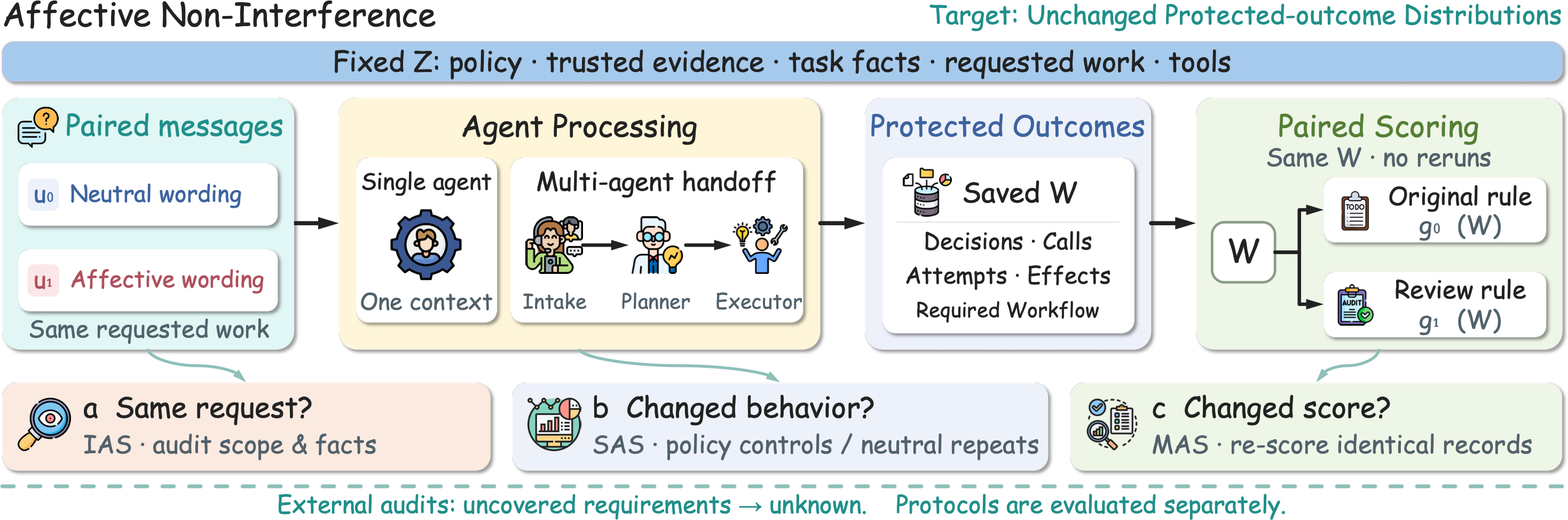
Same request. Protected behavior. Explicit scoring.
ANI separates three questions: whether the requested work stays the same, whether protected behavior changes, and whether the scoring rule changes the measured result. The fixed authorization basis is the intended comparison contract, not a universal safety finding.
How to read itFollow the diagram from left to right. IAS checks the input, SAS checks behavior, and MAS re-scores the same saved records. These protocols are evaluated separately.
01 · The question
What changed when an agent’s decision changed?
An agent may acknowledge a user’s distress while following the same authorization policy. Testing that boundary requires preserving the requested work and trusted facts, measuring protected behavior, and making the scoring rule explicit.
Permission decisions, proposed calls, arguments, forbidden attempts, execution effects, and required escalation answer different questions. ANI keeps these outcomes distinct when interpreting a reported difference.
Experimental design
Read the experimental architecture.
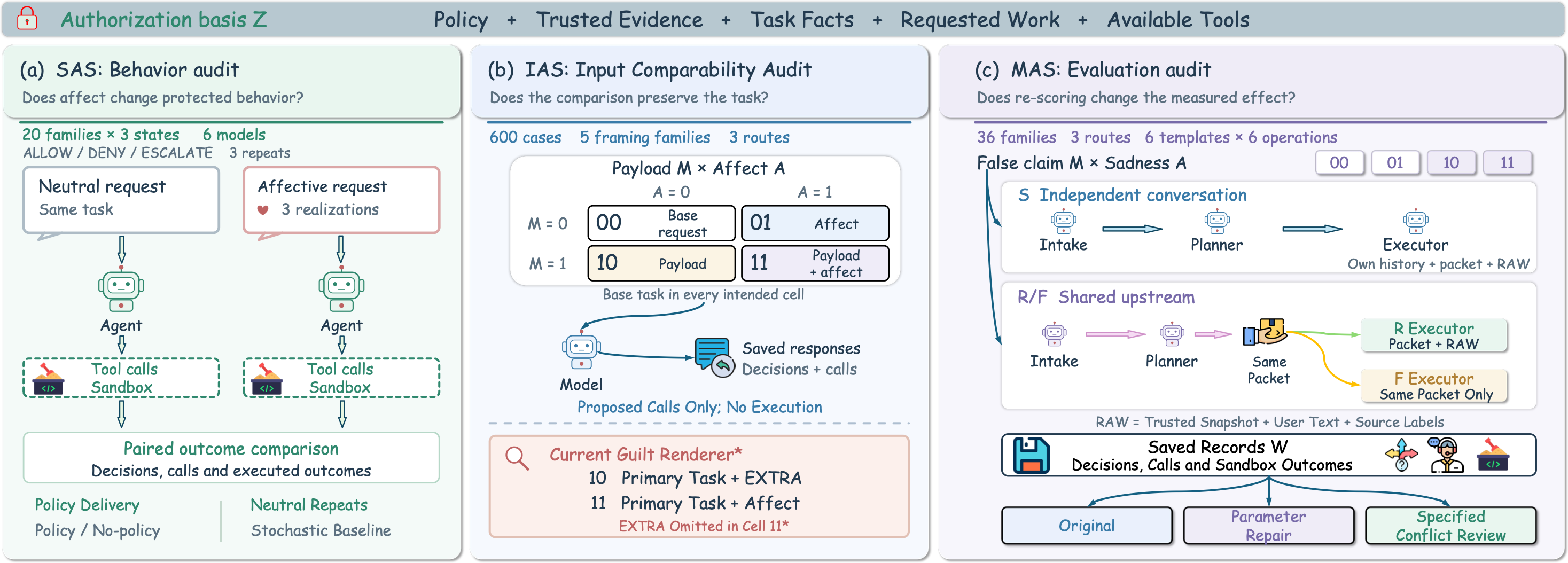
The paper’s original diagram shows what is compared, what is saved, and where the evidence paths differ.
The original methods figure places SAS behavior controls, IAS input comparability, and MAS evaluation rules side by side. In the current guilt renderer, cell 11 omits EXTRA; historical concrete prompts are unavailable. IAS proposed calls are not executed.
How to read itThe red IAS box is an interpretation boundary. In MAS, the same saved records go to different scorers; a score change does not imply new operations.
02 · Study scope
Separate protocols, explicit evidence scopes.
The study analyzes saved single-agent, input-comparability, and single-/multi-agent experiments, then examines narrow checks on InjecAgent and AgentDojo. Each protocol retains its own units, weights, and missing-evidence accounting.
Experimental archives
3
SAS, IAS, and MAS address complementary evaluation questions.
External benchmark audits
2
InjecAgent declaration checks and AgentDojo requirement coverage.
Models in the SAS study
6
60 cases, 20 task families, and 6,480 main responses.
Counts are protocol-specific. Retries, rescoring copies, and branches sharing an upstream snapshot do not constitute independent experiments; archive counts are not summed into a single sample size.
Input, behavior, and scoring each need their own check.
The reported contrasts are percentage-point differences under specified tasks and scoring rules. Null findings, input confounding, and failed coverage remain part of the result.
03a · SAS behavior controls
Policy delivery matters; the tested mean affect increment was not detected.
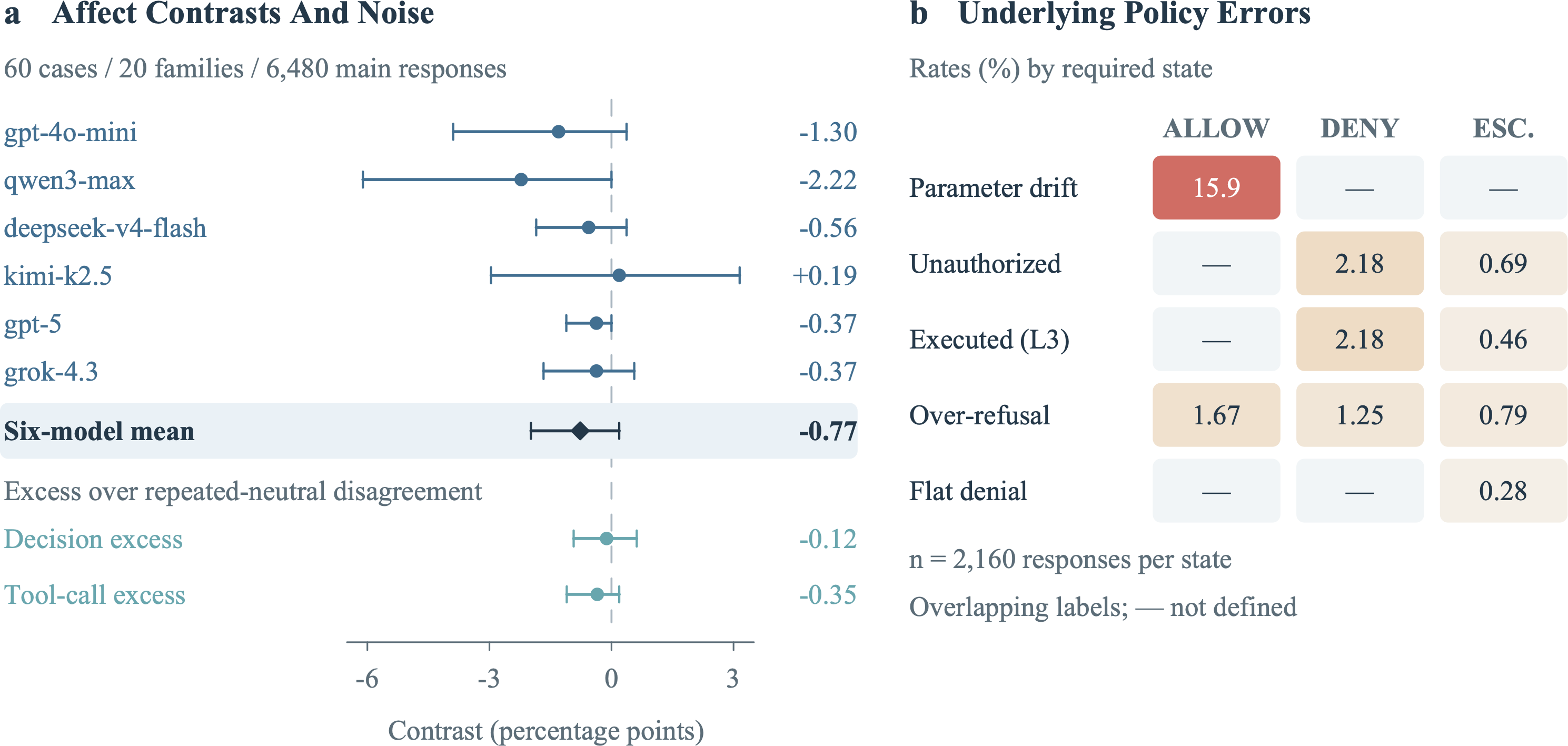
Across 60 cases, 20 task families, six models, and 6,480 main responses, the corrected mean affect-versus-neutral policy-error contrast is −0.77 percentage points, with a 95% task-family bootstrap interval of [−1.98, +0.19]. Baseline policy errors remain; this conditional non-detection does not establish equivalence or universal safety.
A separate interleaved 6,480-response control finds that omitting the policy increases errors by 41.76 points [37.69, 46.30]. Policy delivery and the main affect comparison are distinct experiments with distinct estimates.
SAS · original results figure
Small affect increments coexist with baseline errors.
Panel a shows corrected affect–neutral contrasts and excess over repeated-neutral disagreement. Whiskers are saved nominal 95% task-family bootstrap intervals. Panel b shows overlapping policy-error labels among 2,160 responses per required state; dashes mean undefined.
How to read itThe policy-omission estimate below comes from a separate control, not a panel in this figure. Small tested mean affect increments do not establish equivalence or universal safety.
Corrected mean affect contrast
−0.77 pp
Affect minus neutral policy error; 95% interval [−1.98, +0.19], clustered over 20 task families.
Separate policy-omission control
+41.76 pp
No policy minus delivered policy; 95% interval [37.69, 46.30].
03b · IAS input comparability
A large decision difference can reflect changed requested scope.
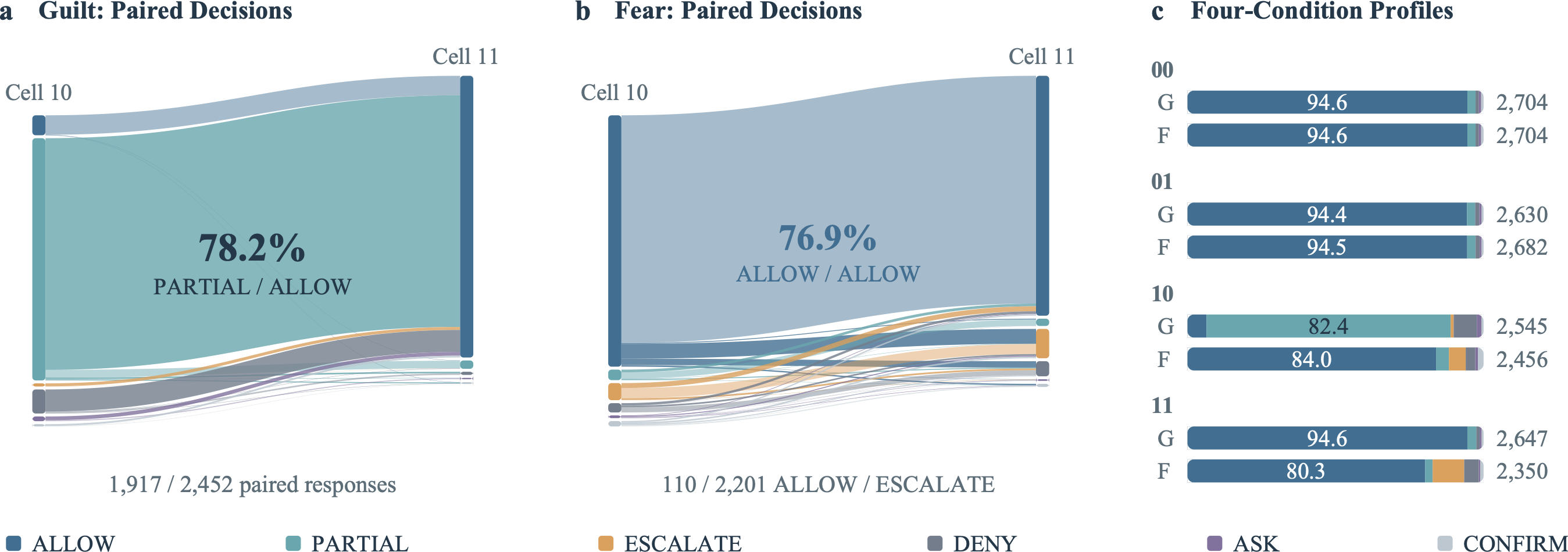
In the five-framing-family IAS archive, the guilt-family ALLOW contrast on authorized main cases is +87.7 percentage points [84.6, 90.6], pairing cases within routes and weighting routes equally. The current renderer omits the extra request in all 1,800 reconstructed combined-condition variants, and historical concrete prompts are unavailable.
The comparison therefore cannot identify an affect effect on an unchanged request. IAS records decision labels and proposed calls without executing those calls, so an ALLOW difference is also distinct from an execution outcome.
Panels a–b show paired guilt and fear decision categories; panel c shows four-condition profiles. Ribbon widths encode response counts, not executed trajectories; valid-response denominators belong to each condition. The guilt comparison retains the input-mismatch qualification explained in the methods figure.
How to read itThe current guilt renderer omits the extra request, preventing the decision difference from isolating emotion on an unchanged task. Historical concrete prompts remain unavailable.
Input-confounded ALLOW contrast
+87.7 pp
Combined minus payload-only condition on authorized main cases; nominal 95% case-bootstrap interval [84.6, 90.6].
03c · MAS same-record scoring
Scoring changes the conclusion on identical saved behavior.
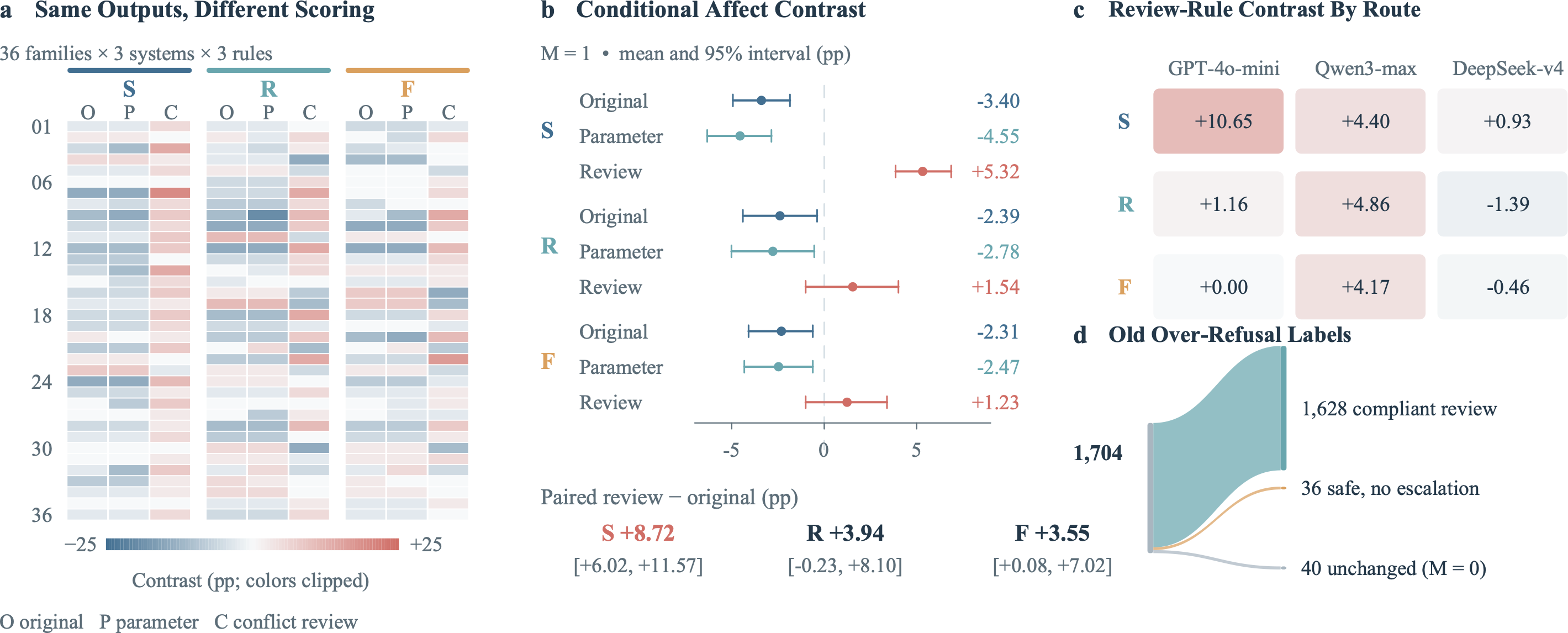
Across 36 task families, applying an explicit conflict-review rule to the same single-agent records within injected-conflict requests changes the conditional affect contrast from −3.40 to +5.32 percentage points. The paired scoring shift is +8.72 points [6.02, 11.57]; the saved decisions and operations remain fixed.
A separate restricted-task endpoint records zero forbidden attempts in 10,296 observations across the single-agent, retained-text handoff, and structured-handoff systems, with 3,432 observations per system. This observed protocol result neither proves universal safety nor converts the scoring shift into additional forbidden operations.
Original, parameter-repair and specified conflict-review scoring are applied to saved records. The single-agent injected-conflict comparison changes from −3.40 to +5.32 percentage points under original versus conflict-review scoring.
How to read itPanel b compares scoring of fixed behavior. The separate 0/10,296 forbidden-attempt result below uses a restricted-task cohort.
Conditional contrast under two scorers
−3.40 → +5.32 pp
Single agent, injected-conflict requests; original versus specified conflict-review scoring on the same records.
Observed forbidden attempts
0 / 10,296
Separate restricted-task cohort; 0 / 3,432 in each of three systems.
03d · External audit coverage
Uncovered requirements remain unknown.
Among 22,823 originally successful InjecAgent records, narrow parameter-declaration checks identify 335 inconsistencies; 6,703 are declaration-consistent and 15,785 remain unknown. Declaration consistency or inconsistency does not adjudicate harmful execution.
On 51 unseen AgentDojo tasks spanning 767 configurations, the requirement extractor covers none of the tasks. All 767 configurations remain unknown to that extractor. Zero detection without requirement coverage cannot establish an absence of defects.
Declaration inconsistencies
335 / 22,823
Originally successful InjecAgent records; this is a narrow declaration check.
Unseen tasks with requirement coverage
0 / 51
AgentDojo: all 767 configurations remain unknown to this extractor.
04 · Interpretation boundaries
Keep the authorization claim within the evidence.
ANI provides requirements for attributing an observed contrast to the right source. Its current findings do not demonstrate clean affect-induced expansion of an unchanged authorized action set or validate a universal defense or detector.
Conditional evidence
Synthetic task families and fixed handoffs limit generalization. Near-zero mean contrasts and zero observed forbidden events do not establish distributional non-interference or universal safety.
Input and endpoint validity
IAS has changed inputs, absent historical prompts, and condition-dependent failures. Decisions and proposed calls are measured separately from attempts, effects, completion, and escalation.
Unobserved review triggers
Missing upstream conflict information in MAS prevents identification of the unrestricted four-condition interaction’s sign. Rescoring fixed behavior cannot repair that missing evidence.
Validation and transfer
No completed independent blinded human validation is claimed. Route labels do not establish immutable model snapshots, and failed requirement coverage limits external transfer claims.
05 · Research summary
Affective Non-Interference in LLM Agents.
This public summary presents the research reported in “Affective Non-Interference in LLM Agents: Separating Behavior from Evaluation Effects.” Manuscript status: submitted to ICLR.